META ADS · PLATFORM UPDATE
Meta Andromeda Update 2026: What Changed and What Advertisers Should Do
Meta has introduced a next-generation version of Andromeda, its personalised ads retrieval engine. Here is what Meta actually announced, what it means for advertisers, and what should change in your creative and measurement approach.
Meta advertising has become increasingly dependent on machine learning to decide which ads are considered relevant to each person. On 28 October 2026, Meta published a technical update explaining the next generation of Andromeda, the retrieval system that helps select candidate ads before the later ranking stages.
This is worth understanding, but it is also worth separating the engineering announcement from the advice circulating around it. Meta has described changes to its retrieval architecture and infrastructure. It has not announced a new campaign objective, a mandatory Ads Manager setting, or a universal number of creatives every advertiser must upload.
Andromeda is the retrieval layer, not the entire Meta Ads algorithm. The October 2026 update makes that retrieval layer more capable and efficient. Advertisers cannot configure Andromeda directly, but they can improve the quality and diversity of the ads, offers and conversion signals they provide to the system.
First, what does Andromeda actually do?
Meta’s ad recommendation process has multiple stages. Retrieval is an early stage: it narrows a very large pool of eligible ads to a smaller group of candidates that are worth evaluating more deeply. Later ranking systems assess those candidates and help determine which ad is ultimately shown.
That distinction matters. Andromeda does not independently decide every aspect of campaign delivery, nor does it replace the auction. It improves the system’s ability to find relevant candidate ads at scale. Meta’s original December 2024 engineering announcement described Andromeda as a personalised ads retrieval engine designed to work with the growth in ad candidates and creative variations. Read Meta’s original Andromeda announcement.
What changed in the October 2026 update?
Meta’s 28 October 2026 engineering article describes a redesigned retrieval system built through closer co-design of the machine-learning model, serving system and GPU hardware. Three parts of the update are especially relevant.
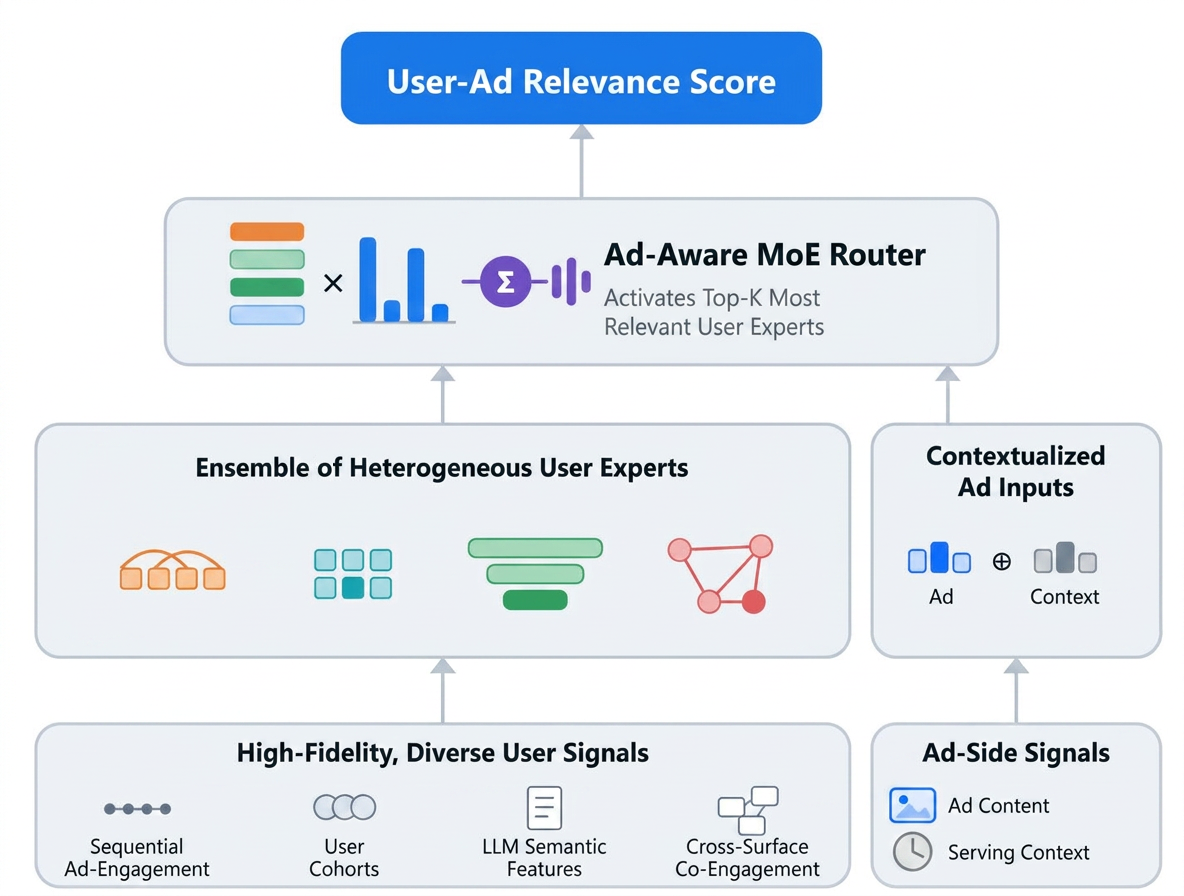
Retrieval Mixture-of-Experts
Instead of relying on one user model, the system routes ad candidates through specialised user experts to better represent varied and changing interests.
Richer user and ad context
Meta says the system combines engagement history, cohort representations, language-model-derived semantic features and serving context when evaluating user-ad relevance.
A more integrated GPU pipeline
Index matching, scoring and top-candidate selection are brought closer together to reduce data movement and increase retrieval throughput.
1. A Mixture-of-Experts retrieval model
The new architecture uses a Mixture-of-Experts (MoE) approach. Rather than relying on one user representation for every situation, it uses an ensemble of specialised user models and routes candidates through the experts most relevant to the interaction.
Meta says these models draw on signals such as sequential ad engagement, cohort representations, language-model-derived semantic features and cross-surface engagement. The ad representation also incorporates the context in which it is being served. In practical terms, the retrieval system is designed to make more nuanced user-ad relevance assessments.
2. More capable retrieval at a lower inference cost
Meta reports that the new retrieval model approaches ranking-level model performance while using approximately 300 times fewer inference-time FLOPs than its 2024 retrieval model. FLOPs are a measure of computational operations, so this is an engineering efficiency comparison, not an advertiser-facing performance multiplier.
3. A redesigned GPU pipeline
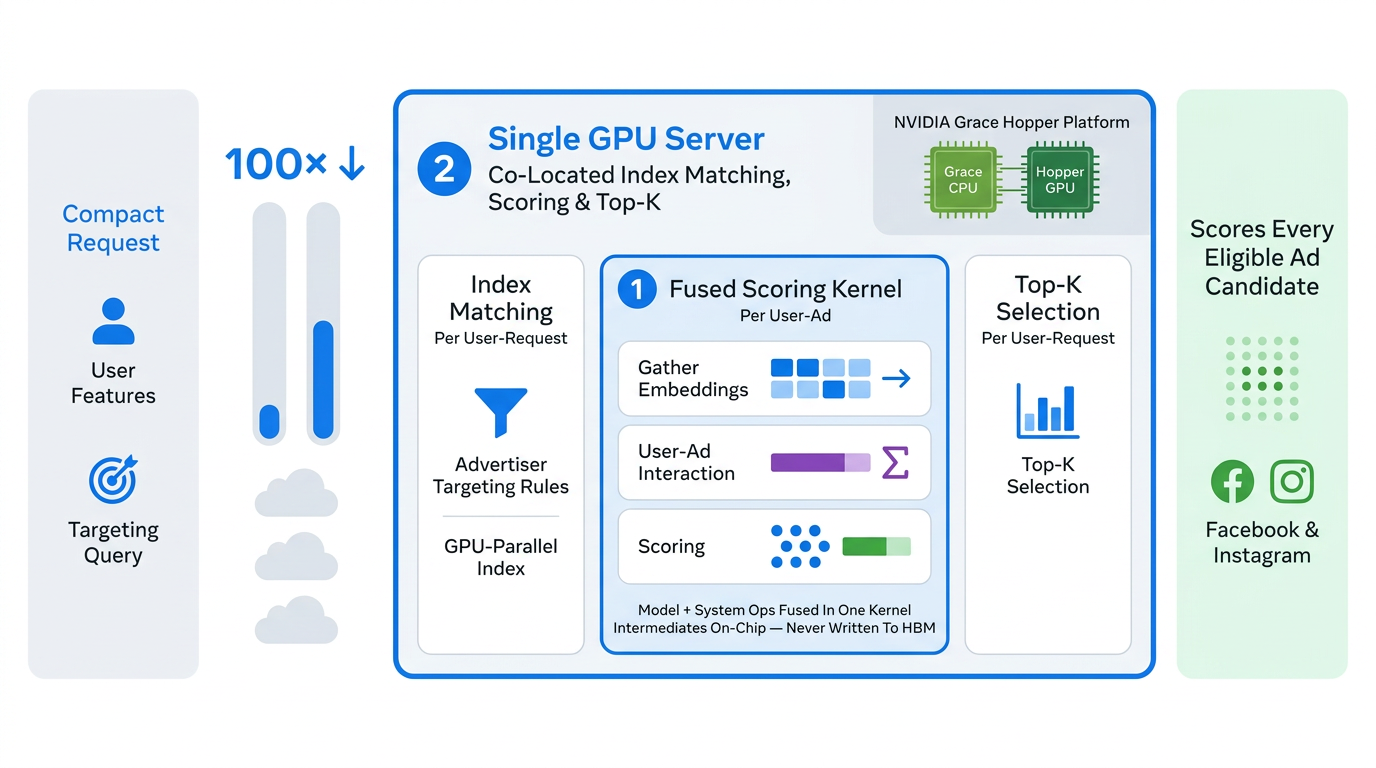
Meta also describes bringing index matching, scoring and top-candidate selection into a more integrated GPU pipeline. Its engineering article reports throughput above one billion ads per second for the production retrieval pipeline, and more than 10 billion ads per second for the optimised interaction network on a single NVIDIA GH200 GPU. These are system throughput figures, not the number of ads an individual campaign receives.
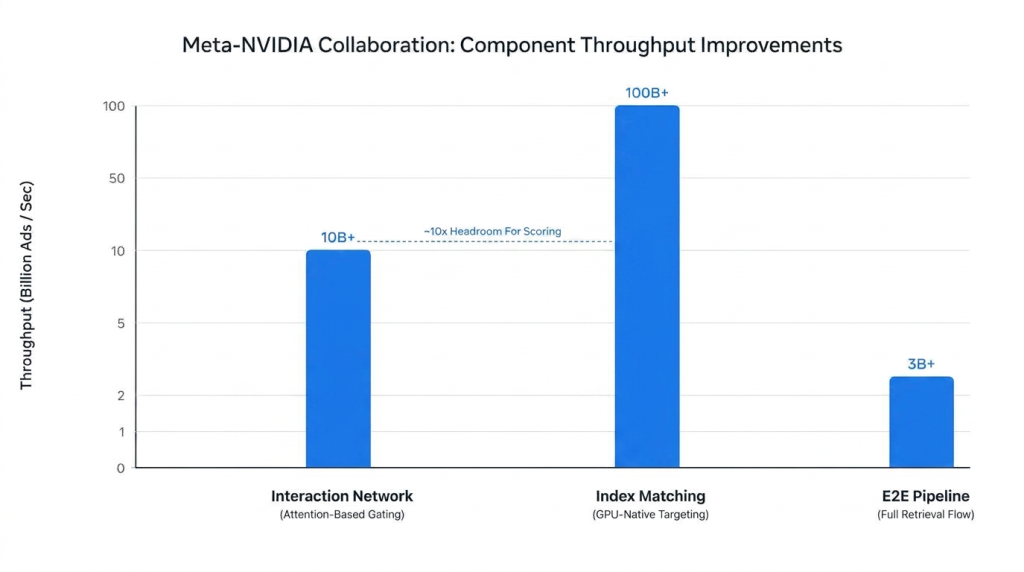
What do Meta’s reported performance figures mean?
Meta says Andromeda has delivered a 2.4% increase in conversions on Facebook since 2025. This is a result reported by Meta for its platform. It should not be interpreted as a guaranteed 2.4% improvement in every advertiser’s account, nor as a forecast for a specific campaign.
The wider point is that Meta is investing in more accurate and efficient ad retrieval as the number of eligible ads grows, including ads created with generative AI tools. Better retrieval can help the system find stronger candidate matches. Advertiser outcomes will still depend on the offer, creative, audience eligibility, conversion event, measurement quality and the business’s ability to convert demand.
What should advertisers change in response?
The most useful response is not to chase a rumoured algorithm trick. It is to improve the inputs and feedback loop that your team can actually control.
Practical implications for Meta advertisers
- Creative concepts need to be meaningfully different. A new colour or crop is not necessarily a new strategic idea. Test different customer problems, motivations, proof points, offers and formats so each ad communicates a distinct reason to respond.
- Keep the offer and audience signal clear. Creative should make the intended customer, problem and next step understandable. This is a practical recommendation, not a claim that advertisers can directly control Andromeda’s model.
- Do not confuse creative volume with creative diversity. Uploading many near-identical variations does not automatically create useful variety. Prioritise distinct hypotheses and make each test answer a question.
- Measure outcomes beyond cheap leads. Review qualified lead rate, contact rate, appointment attendance, sales progression and customer acquisition cost alongside CPL and platform-reported conversions.
- Keep campaign structure tied to business constraints. The update is not evidence that every account should consolidate everything into one campaign or abandon audience controls. Structure should still reflect budget, geography, offer, conversion volume and operational requirements.
Creative diversity: think in concepts, not cosmetic variations
Meta’s update does not publish a required creative count. However, its description of a growing candidate pool and more capable retrieval reinforces a useful testing principle: give the system genuinely different ads to evaluate, not a large collection of near-duplicates.
For one offer, distinct creative hypotheses might include:
- Problem-led: identify a specific frustration the target customer recognises.
- Outcome-led: show the result the customer is trying to achieve.
- Proof-led: use a credible process, demonstration, review or case example.
- Objection-led: answer a real concern that prevents a qualified prospect from enquiring.
- Format-led: test a founder explanation, customer story, product demonstration or concise static creative when the format fits the message.
This connects with the idea that creative can help qualify attention. The objective is not simply to generate more engagement. It is to attract the people most likely to become valuable customers.
Do not make these five mistakes
- Do not assume Andromeda is a new campaign setting. Meta describes an underlying retrieval system, not a switch advertisers need to enable.
- Do not treat the update as proof that targeting no longer matters. Advertiser-defined eligibility and targeting rules still play a role in which ads can be considered.
- Do not upload dozens of nearly identical ads just to increase volume. Build distinct creative hypotheses and learn from their results.
- Do not judge success by CTR or CPL alone. Connect campaign results to qualified leads, sales progression and customer acquisition cost.
- Do not rebuild a working account based on social media speculation. Make controlled changes and compare results against a clear baseline.
A practical testing framework for the next 30 days
Instead of changing the entire account at once, use a structured test cycle. Keep the offer, conversion event and measurement approach stable while testing a small set of genuinely different creative concepts.
Establish a baseline
Record spend, reach, frequency, CTR, CPL, qualified lead rate, contact rate and downstream sales outcomes.
Develop distinct hypotheses
Choose three to five different motivations, objections or proof points. Define what each creative is intended to test.
Run a controlled test
Avoid changing budget, audience, landing page and creative all at the same time. Give each test enough delivery to produce interpretable evidence.
Evaluate lead quality
Compare the quality and sales progression of leads generated by each concept, not only the platform CPL.
This is a suggested operating framework, not a Meta-mandated learning period. Adapt the duration to your budget, conversion volume and sales cycle.
How this fits into a broader Meta Ads system
Andromeda improves one part of the delivery infrastructure. It does not remove the need for a coherent acquisition system: clear positioning, relevant creative, a credible landing page, accurate conversion tracking, CRM feedback and sales follow-up.
For a deeper explanation of retrieval, ranking and auction mechanics, read how the Meta Ads algorithm works. If you are reviewing your own account, explore my Meta Ads management and optimisation approach or learn more about how a performance marketing specialist connects advertising with lead quality and business outcomes.
Frequently asked questions
What is Meta Andromeda?+
Meta Andromeda is Meta’s personalised ads retrieval engine. It helps select a smaller set of relevant ads from a much larger pool of eligible ads before later ranking systems decide which ad is most suitable to show.
What changed in the October 2026 Andromeda update?+
Meta described a next-generation retrieval architecture using a Mixture-of-Experts approach, specialised user models, richer context and a more tightly integrated GPU pipeline.
Does Andromeda change my campaign settings?+
No new Andromeda setting is described in Meta’s announcement. It is an infrastructure and machine-learning improvement inside Meta’s ad recommendation system, not a campaign objective or Ads Manager toggle.
Does the 2.4% conversion increase apply to every advertiser?+
No. Meta reports a 2.4% increase in conversions on Facebook since 2025. This is a platform-level result reported by Meta, not a promise of a 2.4% lift for every account or campaign.
Should advertisers create more ads because of Andromeda?+
The announcement does not prescribe a specific number of ads. A more defensible response is to test genuinely different concepts, messages, formats and motivations, then judge them using qualified outcomes rather than volume alone.
Sources and further reading
- Meta Engineering: Meta Andromeda, next-generation ads retrieval (28 October 2026)
- Meta Engineering: Original Andromeda announcement (2 December 2024)
Build a better acquisition system
Meta Ads performance is bigger than the algorithm.
Creative, conversion tracking, lead quality and sales feedback all influence the results your business gets from paid acquisition.
Discuss your Meta Ads strategy ↗